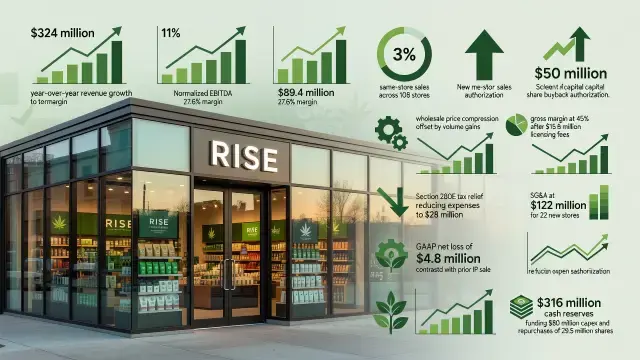
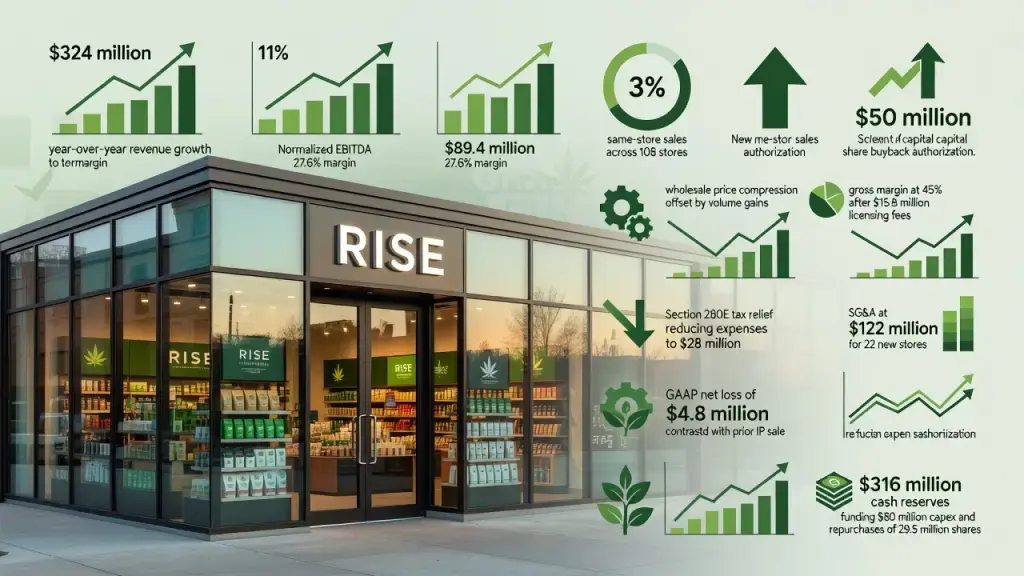
Green Thumb Industries (OTC: GTBIF) reported third-quarter fiscal 2026 revenue of $324 million, up 11% year-over-year, as new adult-use sales in Minnesota and steady gains in established markets outweighed continued wholesale pricing compression. Normalized EBITDA climbed to $89.4 million, a 27.6% margin, while same-store sales turned positive for the first time in roughly a year. The multi-state operator also authorized a new $50 million share buyback, signaling confidence in its cash position even as GAAP results swung to a net loss.
Retail Rebound Meets Wholesale Headwinds
The headline number here is the same-store sales reversal: a 3% increase across Green Thumb's base of 108 stores, up from a 1% decline the prior quarter. That matters more than it might seem at first glance. Comparable sales are the cleanest signal of whether a dispensary chain's existing footprint is actually gaining traction with consumers, as opposed to simply adding new store count to mask stagnation. Retail revenue overall grew 10% year-over-year, with Minnesota's adult-use launch doing much of the lifting alongside continued strength in Florida, Ohio, Virginia, and Illinois.
The CPG side told a similar story - gross revenue up 16%, again led by Minnesota, with expansion in Illinois, New Jersey, New York, and Ohio. But here's the catch: that growth came "partially offset by price compression and increased competition." In practice, that's the industry's recurring tension in a nutshell. New markets open, wholesale menus fill up fast, and pricing softens almost as quickly as volume builds. Brands chasing shelf space in a newly legal market often find the honeymoon period for favorable wholesale pricing is short-lived once supply catches up with demand.
Margins, Licensing Fees, and What's Really Happening Underneath
Gross margin fell from 49% to 45% year-over-year, which on paper looks like deteriorating unit economics. It isn't, not entirely. The company attributes the bulk of that contraction to $15.8 million in brand licensing fees booked in the quarter - a one-time or at least non-recurring cost rather than a structural erosion in product economics. Strip that out, and management says normalized margins actually improved slightly. That distinction matters for anyone trying to read through to the core business: pricing compression is real, but it isn't yet eating into the fundamentals the way a straight GAAP comparison might suggest.
SG&A told a more straightforward story - up to $122 million, or 38% of revenue, from $107 million a year earlier, driven by compensation costs and the expense of opening and running 22 incremental retail stores. Store growth isn't free. New locations carry buildout costs, staffing, point-of-sale deployment, and compliance infrastructure - seed-to-sale tracking integration, security systems, local permitting - well before they contribute meaningfully to the top line. That's a normal cost curve for an operator still opening doors, but it's worth watching whether the pace of new-store SG&A growth stays proportional to the sales lift those stores eventually deliver.
The Tax Picture and Why 280E Keeps Coming Up
Income tax expense dropped to $28 million from $49 million, and the company points to Section 280E no longer applying to its medical cannabis business as a driver. For readers outside the finance department: 280E is the federal tax code provision that bars cannabis businesses from deducting ordinary business expenses because the plant remains federally illegal, which historically has left operators facing effective tax rates far higher than companies in any other industry. Any erosion of that burden - whether through rescheduling to Schedule III or selective relief like what Green Thumb describes on its medical segment - flows fairly directly to free cash flow. That's part of why federal rescheduling discussions carry outsized weight for multi-state operators' balance sheets, even before recreational legalization questions are settled.
The GAAP net loss of $4.8 million, against a $23.3 million profit a year ago, looks alarming until you account for the prior year's $42 million gain from an IP sale. Remove that non-operating item and the comparison flattens considerably. It's a reminder that headline GAAP figures for cannabis operators often need a second look - one-time gains, licensing fee timing, and tax treatment can swing results in ways that don't reflect the day-to-day retail and wholesale business.
Capital Allocation Signals
With $316 million in cash on hand, Green Thumb has room to maneuver. Since the fourth quarter of fiscal 2024, the company has returned more than $200 million to shareholders, repurchasing roughly 29.5 million shares - about 13% of the company - at an average price near $7. The new $50 million authorization, paired with planned fiscal 2026 capital expenditure of about $80 million excluding real estate, suggests a balanced approach: continued store openings, six new RISE locations this quarter in Florida, Nevada, and Pennsylvania, alongside ongoing buybacks rather than a pivot toward large-scale acquisitions. For an industry still working through federal banking restrictions and limited access to traditional capital markets, that kind of self-funded flexibility is not something every operator can claim.