As of July 1, Kentucky's 26,000 active medical cannabis cardholders lost the legal protection that had allowed them to purchase products in neighboring states and bring them home. The executive order that created that buffer - issued in 2022 by Gov. Andy Beshear - has been rescinded, replaced by the assumption that Kentucky's own licensed market is now operational enough to serve patient demand. For dispensary operators, compliance officers, and cultivators now building out the state's intrastate supply chain, the policy shift signals both a market opportunity and a new layer of enforcement pressure on both sides of the transaction.
The 2022 pardon was always designed as a stopgap. Sam Flynn, special advisor to Gov. Beshear and former executive director of the Office of Medical Cannabis, described the rescission as the original plan executing on schedule - not a reversal. That kind of regulatory sequencing is familiar to operators in established markets. States that have built medical programs from scratch consistently face an early window where patient demand outpaces licensed supply, and a policy bridge of some kind fills the gap. Ohio, Illinois, and Missouri - all border states with legal cannabis - served that function for Kentucky cardholders. So did Virginia and West Virginia to the east. The distinction between those markets' compliance frameworks and Kentucky's emerging one is something operators familiar with systems like Michigan cannabis POS infrastructure would recognize: intrastate tracking, seed-to-sale accountability, and state-specific labeling requirements simply don't transfer across state lines, regardless of cardholder status.
With the pardon gone, Kentucky is now an insular intrastate market - Flynn's own phrase - with 17 dispensaries covering most of the state. That's not a wide footprint. Southeastern Kentucky is notably underserved, and that's a problem worth naming directly: the patients who had the most practical reason to cross into Virginia or West Virginia for a closer dispensary now have no compliant path to do so. For a region with limited retail infrastructure generally, that gap isn't trivial. Operators scouting future license opportunities would be wise to take note of the geographic concentration in the current build-out.
Packaging and Law Enforcement Identification Are the Compliance Front Line
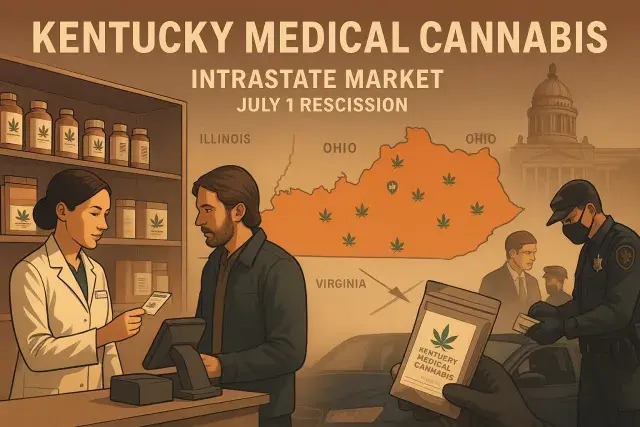
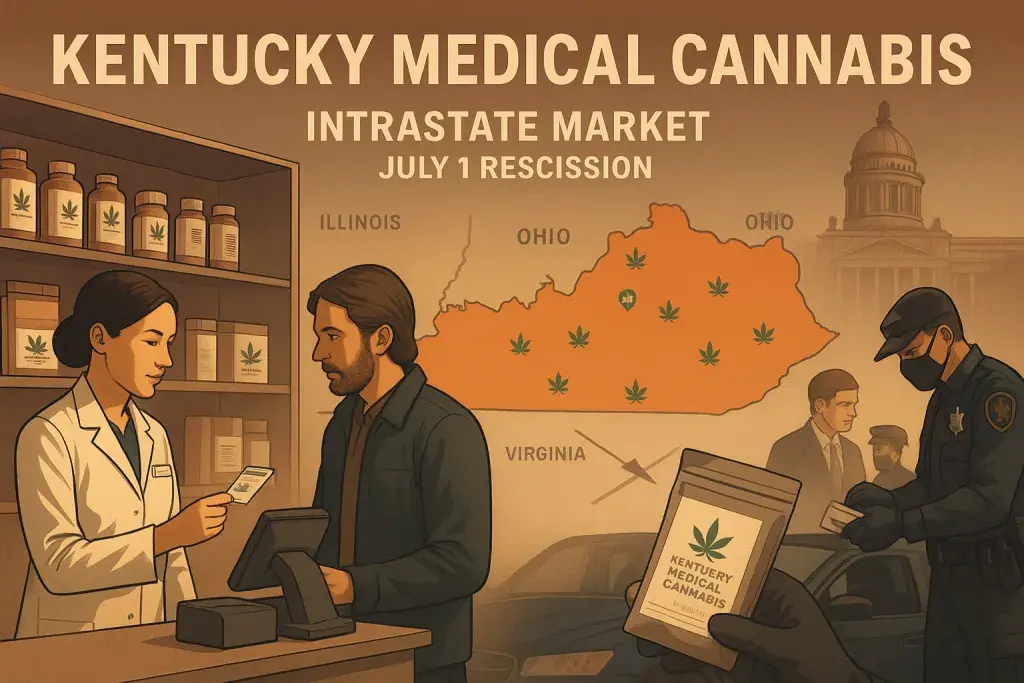
Kentucky-manufactured cannabis products carry a state-specific symbol on their packaging - and that detail matters more than it might seem. Flynn noted that law enforcement across the commonwealth has been trained to distinguish Kentucky-produced products from out-of-state ones on sight. That means any cardholderbringing in product purchased elsewhere is now carrying something an officer can identify as non-compliant without a lab test or chain-of-custody document. For dispensary operators, the practical implication runs in the opposite direction: proper compliant packaging isn't optional or aesthetic - it's what separates a legitimate sale from a compliance liability in a roadside encounter. Labeling standards, state symbols, and batch identification aren't just regulatory box-checking; they're the mechanism by which the state enforces its market boundary.
Building an Intrastate Market from Scratch Carries Real Operational Weight
Flynn's description of Kentucky's program as "moving at quite a great speed" is encouraging on its face. In practice, though, a highly regulated intrastate market with a cardholders-only purchase requirement, a lottery-based licensing process, and a relatively modest active patient count presents specific economic pressures for early-stage operators. Wholesale pricing, inventory management, and cultivator throughput all have to calibrate to a restricted buyer pool - no adult-use spillover, no interstate commerce, no tourist sales. Every SKU on a Kentucky dispensary's wholesale menu has to move exclusively through licensed in-state channels to verified cardholders.
That's a lean margin environment, particularly for processors and cultivators building out production capacity ahead of demand certainty. The 26,000 active cardholders represent a defined ceiling on the immediate addressable market - one that will grow as more qualifying patients seek cards and as southeastern coverage improves, but not quickly. Operators used to adult-use volume in states like Missouri or Illinois should think carefully before projecting those economics onto Kentucky's current structure. This is a medical-only program, and patient acquisition is gated by qualifying conditions, physician recommendations, and card registration - not foot traffic or brand recognition.
What the Policy Shift Means for Regional Operators and Compliance Teams
For multi-state operators with dispensaries in Ohio, Illinois, Missouri, Virginia, or West Virginia, the July 1 change is worth tracking for a specific reason: Kentucky cardholders who previously purchased at their locations and transported product back home are now doing so without legal protection. A Kentucky cardholder showing up at a Cincinnati or Wheeling dispensary isn't violating that state's law - but they are now out of compliance with Kentucky's. The destination-state risk is the cardholder's alone. Still, border-state operators may see some softening in cross-border customer volume, particularly among patients who were making those trips specifically because a closer or more affordable option didn't exist at home.
The sharper implication is for Kentucky's own licensed operators: they now have the exclusive legal channel. That's a protected market position - and with it comes the full weight of compliance responsibility. Seed-to-sale tracking, point-of-sale verification of cardholder status, compliant packaging, and proper inventory reconciliation aren't administrative overhead. They are the operating conditions of the license. Flynn's reminder that law enforcement can identify non-compliant product at a glance is, in effect, a reminder to operators that their packaging and tracking practices are visible well beyond the dispensary floor.