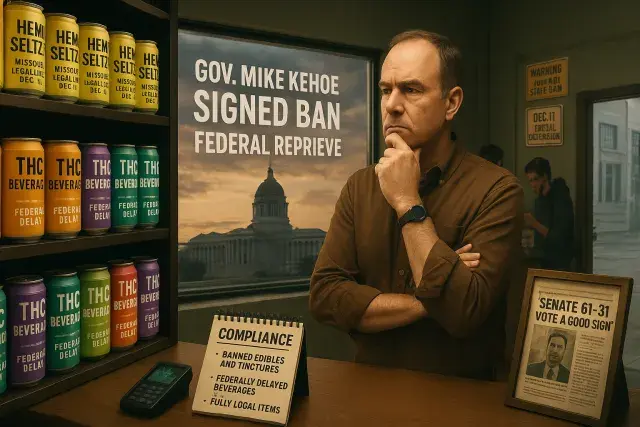
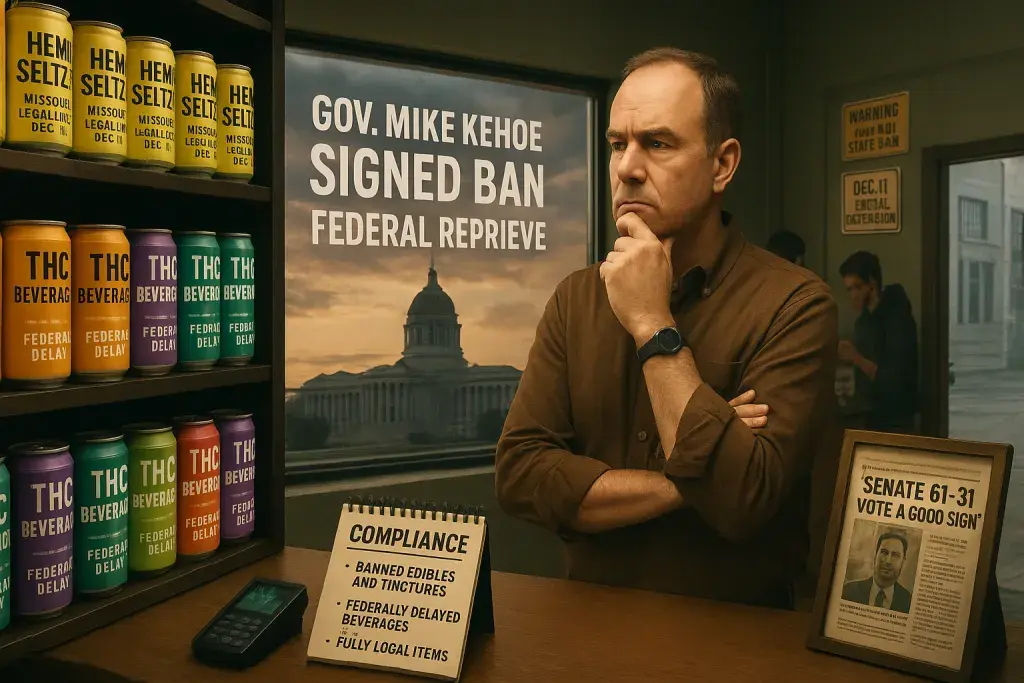
Missouri retailers selling hemp-derived THC beverages got a reprieve of sorts this month, and it didn't come from Jefferson City. It came from Washington. A Senate-approved funding measure would push back the federal ban on intoxicating hemp products until Dec. 11, and because of how Missouri's own law was written, that federal delay could carve out a narrow but real exception for canned seltzers and similar drinks even as the state's broader hemp ban takes effect Nov. 12.
Here's the mechanism worth understanding: Gov. Mike Kehoe signed legislation this spring pulling intoxicating hemp products off Missouri shelves, largely mirroring the federal ban Congress passed last year. But state lawmakers built in a contingency. If Congress delays its own ban, everything except intoxicating beverages stays prohibited in Missouri on schedule - meaning edibles, tinctures, and other hemp-derived THC products still disappear from store shelves regardless of what happens in the House. For operators trying to manage compliant packaging, SKU management, and wholesale menus across state lines, that kind of bifurcated compliance timeline is a genuine operational headache - not unlike the patchwork multi-state operators already navigate when a market like South Dakota cannabis POS infrastructure has to account for entirely different product legality rules than a neighboring state. South Dakota cannabis POS
The bill now heads back to the House for final approval before it can reach the president's desk, and nothing is locked in. Still, the 61-31 Senate vote signals bipartisan appetite for buying more time, and industry advocates see that as meaningful. Jay Patel of the Missouri Hemp Trade Association called the vote a "good sign," while cautioning that a federal delay "is not going to fully solve our problems in Missouri." That's a fair read. A short-term funding extension isn't comprehensive federal regulation - it's a pause button, not a policy.
What Retailers Are Actually Facing
For hemp product retailers, this is a compliance and inventory problem as much as a legal one. Store managers now have to sort their entire product catalog into three buckets: items banned outright under Missouri law regardless of federal action, items that survive only if Congress acts, and items with no ambiguity at all. That's a lot to ask of a compliance log built around a single deadline. John Grady, who owns Slaphappy Hemporium in Rosebud, put it plainly - the beverage carve-out helps his seltzer line but "hurts the whole other part of our business," referring to edibles and other products that face removal no matter what Washington does. Customers, he noted, are already stocking up on items they know will vanish from shelves.
The Legal Challenge Running in Parallel
Separately, the Missouri Hemp Trade Association and a coalition of hemp businesses filed a federal lawsuit last month seeking to block the state ban entirely. The suit, filed in the U.S. District Court for the Western District of Missouri, argues the legislation's definitions distinguishing hemp from marijuana are unconstitutionally vague. That litigation runs on its own clock, independent of whatever Congress decides about the funding bill - meaning operators can't treat the federal delay as a resolution. It's one variable among several, and retailers building compliance plans around a single favorable outcome risk getting caught flat-footed if the lawsuit stalls or the House alters the funding bill's language.
Why the December Deadline Matters More Than It Looks
Assuming the House passes the measure and the president signs it, Dec. 11 becomes the real deadline that matters for hemp beverage makers - not November. That gives the industry roughly a month of runway to push for what advocates actually want: durable federal regulation covering testing standards, labeling, and age-gating, rather than another short-term patch. Grady and others involved in trade coalitions are using this window to lobby for exactly that. Whether Congress delivers before the next funding cliff is an open question, and operators would do well to treat the beverage exception as temporary until proven otherwise.