
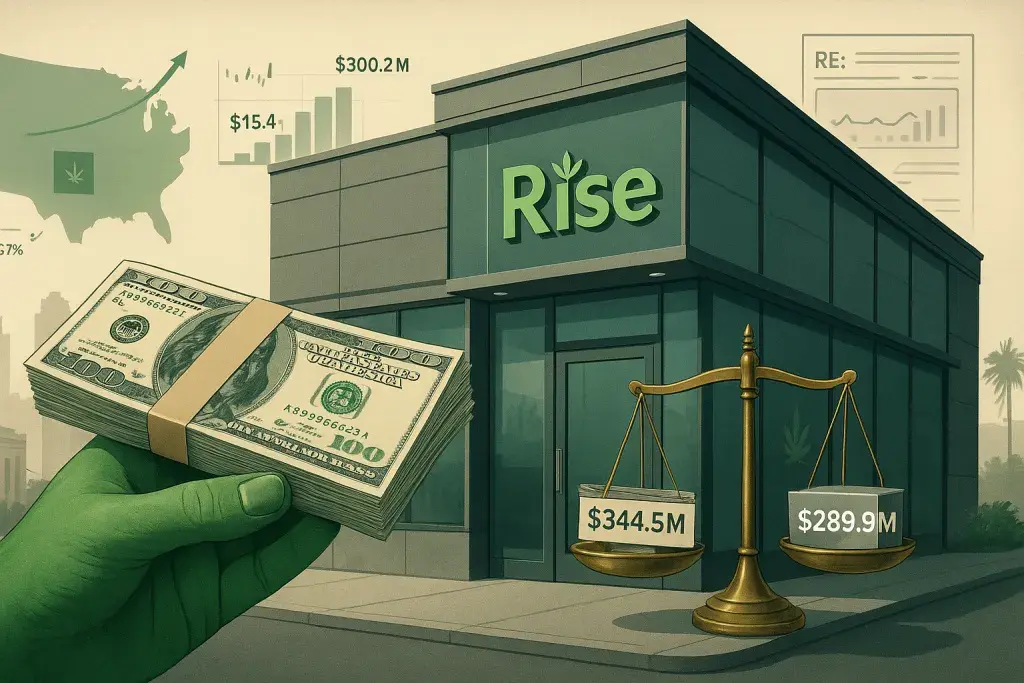
Five years into the legal cannabis experiment, the market has delivered a blunt lesson to anyone still chasing top-line growth as the main scoreboard: revenue means little if it never turns into cash. Operators across the country expanded into new states, stacked up debt to fund construction and licensing fees, and diluted shareholders repeatedly just to keep the lights on in the budroom. Green Thumb Industries largely sidestepped that trap, and its first-quarter numbers show why the company keeps getting singled out as one of the better-managed names in the sector.
The results themselves are unglamorous in the best way. Revenue rose 7.4% year over year to $300.2 million, operating cash flow came in at $76 million, normalized EBITDA hit $93.5 million, and the company posted GAAP net income of $15.4 million. None of that sounds flashy compared to the growth stories that used to dominate cannabis earnings calls, but in an industry where inventory shrinkage, compliant packaging costs, and 280E tax exposure routinely eat into margin, consistent profitability is the rarer achievement. Multi-state operators managing dozens of retail doors also depend on operational infrastructure that rarely gets attention - a dispensary pos system California operators rely on, for instance, has to reconcile seed-to-sale tracking, METRC reporting, and daily till counts without introducing compliance gaps, and that back-end reliability shapes margin just as much as wholesale pricing does. dispensary pos system California
Balance Sheet Strength Over Growth-at-Any-Cost
Green Thumb ended the quarter with roughly $344.5 million in cash and $289.9 million in total debt - a ratio that gives management room to maneuver without scrambling for capital raises. Rather than issuing new shares, which dilutes existing holders and is a habit that sank more than a few cannabis names during the boom years, the company has been buying stock back. It repurchased about 6 million shares for $33.3 million during the quarter, then added another 7.4 million shares afterward, pushing 2025 buybacks to nearly $78 million. That is a real signal, not a symbolic gesture. Management is putting company cash behind the belief that shares are undervalued and that the underlying business throws off enough cash to reward investors while still funding expansion.
Selective Expansion Instead of Chasing Every License
Green Thumb now runs more than 110 Rise dispensaries nationally, with a footprint that spans medical and adult-use markets - a hedge that matters when state-level reform stalls or pricing softens unexpectedly. New activity in Minnesota and Texas reflects a pattern of picking specific opportunities rather than grabbing every available license cap slot. That discipline stands in contrast to operators who overbuilt retail footprints in mature markets, only to face wholesale price compression and shrinking margins once oversupply set in.
What Still Works Against the Sector
None of this erases the structural pressure cannabis operators face. Federal legalization remains stalled, Section 280E continues to impose an outsized tax burden by disallowing standard business deductions, and pricing pressure persists in several saturated state markets. Green Thumb hasn't solved those problems - nobody has. What it has done is build a business that doesn't depend on legislative rescue to stay solvent, which is a different kind of achievement than promising explosive growth once reform arrives.
A Different Kind of Investment Case
Smaller, more leveraged operators could still deliver larger returns if federal policy shifts quickly; that's the nature of higher-risk names. But Green Thumb isn't selling upside speculation. It's selling operational proof - that a cannabis company can generate real cash, protect its balance sheet, and expand without overreaching. In a sector where investors have spent years waiting for fundamentals to catch up with the hype, that alone sets it apart.