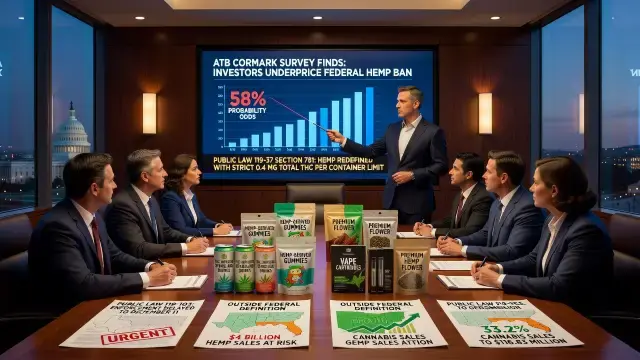
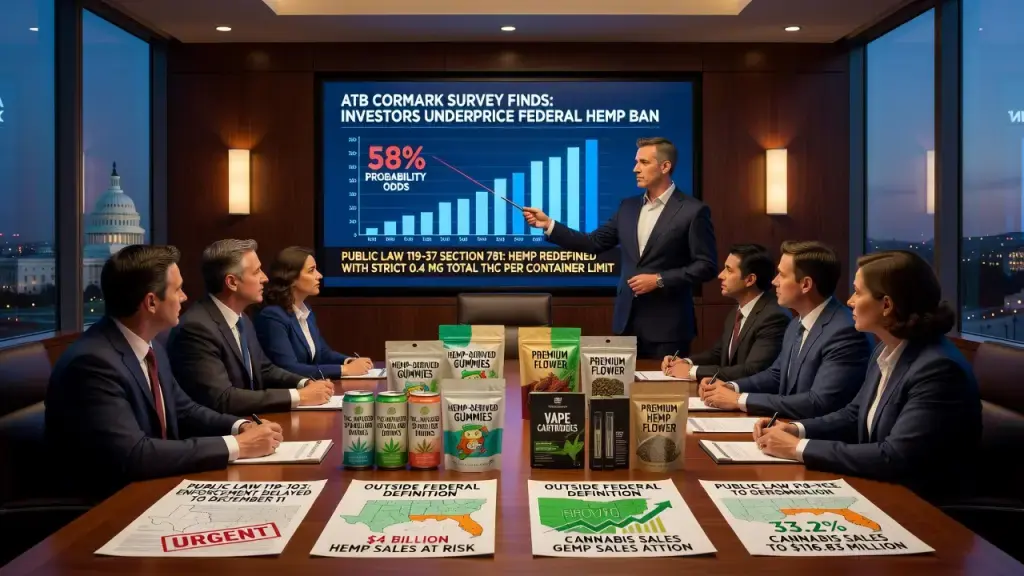
Institutional cannabis investors put the odds of a federal intoxicating hemp ban taking effect at 58%, according to a late-September survey from ATB Cormark Capital Markets. Here's the catch: the ban isn't a probability anymore. It's already law, and the remaining question is one of timing and enforcement, not whether it happens.
A Law Already on the Books
Section 781 of Public Law 119-37, signed in November 2025, redefines hemp and caps finished products at 0.4 milligrams of total THC per container - a threshold low enough to push most THC drinks, gummies, vapes and hemp flower currently on shelves outside the federal definition entirely. A stopgap funding measure, Public Law 119-103, delayed most of those changes to December 11 after clearing the Senate 90-6 and the House 370-48. But products containing cannabinoids the plant can't produce naturally lose hemp status on November 12, regardless. The White House backed the short delay while it works on a broader framework for medicinal THC, Axios reported, but its congressional liaison told Senate Republicans there would be no further extensions. Investors pricing this as a coin flip appear to be grading the wrong exam.
Frederico Gomes, director of institutional equity research at ATB Cormark, argues the skepticism is a hangover from years of federal false starts on rescheduling and banking reform. Fair enough - that history is real. But treating an already-enacted statute like a pending bill is a different kind of risk than betting on legislation that hasn't moved.
Why the Math Matters for Operators
Gomes estimates intoxicating hemp sales could exceed $30 billion annually, rivaling the entire state-licensed cannabis market. Whitney Economics, in a September report, pegged the revenue at risk from stricter hemp rules at $28.3 billion, though that figure folds in non-intoxicating CBD products too - a different basket, not quite the same claim. Beau Whitney, the firm's chief economist, disputes the framing entirely, attributing flat state-market growth to oversupply and price compression inside licensed channels, not hemp competition. "Nothing to do with hemp," he said. Two analysts, same data environment, opposite diagnoses - which tells you how unsettled this debate still is.
For multistate operators, the practical stakes sit in retail footprint and supply chain, not just headline sales figures. A ban that actually sticks means redirected demand into existing dispensary infrastructure - budroom inventory, POS terminals, wholesale menus - largely without new capex. That's the bull case. The survey data shows investors increasingly want capital pointed at M&A and share buybacks rather than organic growth, a shift Gomes reads as operators positioning to capture market share ahead of the change rather than waiting to grow into it.
The Leakage Problem
The thesis assumes hemp customers have a licensed retail option nearby. Much of the country doesn't offer one. Texas and Tennessee have no adult-use market at all. Florida, Gomes's largest example at an estimated $4 billion in hemp sales, is medical-only - a hemp buyer needs a qualifying condition, a physician's certification and a state ID card to walk into a dispensary legally. Roughly 940,000 Floridians hold active patient cards. That's not a small number, but it's a fraction of the population currently buying hemp products at gas stations and smoke shops.
Gomes concedes a portion of demand will leak into illicit or online channels rather than convert. Whitney goes further, arguing THCA flower in particular competes directly with dispensary flower only where dispensaries exist, and that in states that have already restricted hemp, demand simply moved online. Whitney also pushes back on the idea that hemp operates in a regulatory vacuum, noting roughly 38 states already regulate hemp cannabinoids in some form. If federal restrictions land as written, he argues, the compliance imbalance licensed operators have complained about for years doesn't disappear - it just flips direction.
Ohio as an Early Signal, With Caveats
Ohio, which has restricted most intoxicating hemp products since March 20, posted $116.83 million in September cannabis sales, up 33.2% year over year - the largest gain among adult-use states Headset tracks. Gomes calls the hemp restriction an important contributor. Green Thumb Industries made a similar point about Ohio in its second-quarter results. But the state's adult-use market only launched in August 2024, meaning raw growth is still partly a function of a young market finding its footing, not just hemp conversion. A federal judge's preliminary injunction for ten hemp businesses, later narrowed by the Sixth Circuit, also complicates the before-and-after comparison. In practice, though, disentangling the hemp effect from simple market maturation is harder than any single data point suggests.
For dispensary operators, wholesalers and compliance teams, the near-term task isn't betting on probability - it's preparing for enforcement that's already scheduled. That means reviewing product lines against the 0.4 milligram threshold, auditing vendor COAs for synthetic cannabinoids, and watching December 11 as a hard operational deadline rather than a policy talking point.