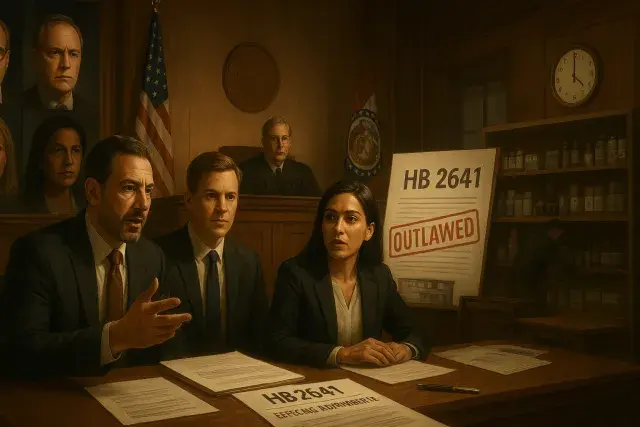
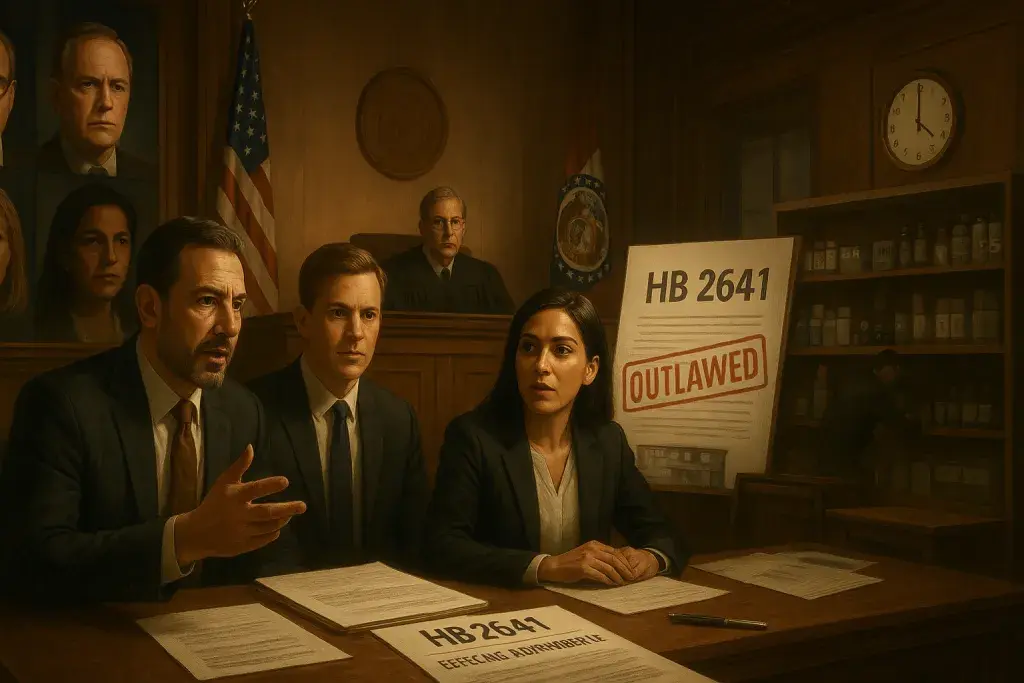
A coalition of Missouri-based and national hemp businesses filed a federal lawsuit Thursday challenging a new state law that would pull all intoxicating hemp products from shelves starting November 12. The suit, filed in the U.S. District Court for the Western District of Missouri, argues that the legislation - House Bill 2641, signed by Gov. Mike Kehoe earlier this year - contains definitions so legally inconsistent that they render the law unconstitutionally vague. At stake is a broad swath of the hemp retail market, from THC seltzers in grocery stores to CBD products in standalone shops.
The plaintiffs include MNG 2005, Inc., parent company of the 55 CBD Kratom chain, the Missouri Hemp Trade Association, and Wisconsin-based Lifted Liquids Inc. The coalition's core argument is structural: the bill allegedly defines the same products as both "hemp" and "marijuana" in different provisions, a contradiction that leaves operators, prosecutors, and law enforcement without a clear legal standard. That kind of definitional ambiguity is not a minor drafting inconvenience - it creates real criminal exposure for businesses that believe they're operating lawfully. Retailers in other regulated markets know this problem well; even operators using compliant cannabis POS in Alaska understand that clear statutory definitions are the foundation on which every compliance protocol, inventory classification, and point-of-sale transaction ultimately rests. When the law itself is internally contradictory, no compliance system can fully protect a business.
Craig Katz, government relations and compliance manager for MNG, put the problem plainly. "A lot of this stuff is kind of in the weeds," he said. "It's very difficult to understand. And when people are trying to legislate it, if they don't understand it, you come up with something like HB2641, which doesn't make a whole heck of a lot of sense." That's not a dismissal of the legislature's intent - it's a fair description of what happens when complex plant-chemistry distinctions get flattened into statutory language by lawmakers without deep industry exposure.
What the Law Actually Does - and Why Operators Are Alarmed
HB2641 is not a narrow measure. It sweeps intoxicating hemp products entirely off general-market shelves - bars, grocery stores, smoke shops - and, if Congress eventually permits them, would restrict their sale exclusively to licensed marijuana dispensaries. That's a significant structural shift. Hemp-derived THC products currently occupy a separate retail channel from licensed cannabis dispensaries, sold under federal hemp provisions without requiring a marijuana license. Confining them to dispensaries would effectively eliminate non-dispensary hemp retailers from carrying these products at all.
The bill also restricts who may transport hemp products through Missouri, which the coalition argues conflicts with interstate commerce protections. And its effective date provisions are, by the coalition's account, layered enough that businesses cannot determine with confidence which products are covered on which date. For any operator managing SKU-level inventory across multiple store locations, that kind of ambiguity is operationally untenable - you cannot pull products from shelves if you don't know which products the law actually covers.
There's a further wrinkle. The coalition argues that the bill's vague definitions will pull non-intoxicating CBD products off shelves alongside THC items - an outcome that would harm a much wider set of retailers, including health-oriented shops with no connection to intoxicating products. If that reading holds up, the compliance blast radius here is considerably larger than the law's stated intent.
The Federal Alignment Argument - and Its Limits
Rep. Dave Hinman, the bill's Republican sponsor, has framed HB2641 as Missouri aligning state enforcement with the federal hemp ban Congress approved last year. "Missouri will mirror the federal government," he said, characterizing the lawsuit as a last-ditch effort unlikely to succeed. That's a reasonable policy position on its face - states routinely use federal action as a template for state-level enforcement.
Here's the catch, though. The lawsuit isn't arguing that Missouri shouldn't regulate intoxicating hemp. It's arguing that the specific statutory language Missouri chose to do so is legally defective. Those are distinct claims. A state can have a legitimate regulatory goal and still produce a law that fails constitutional review on definitional or commerce grounds. Federal alignment doesn't immunize a bill from vagueness challenges if its operative terms genuinely contradict each other within the same text.
The defendants - Gov. Kehoe, Attorney General Catherine Hanaway, and DHSS Director Sarah Wilson - have declined to comment, citing pending litigation. Hanaway's office said it had not yet been served. The clock, however, is running. November 12 is the effective date, and courts will need to move quickly if the coalition's request for a halt is to have any practical effect.
The Bigger Industry Question: Regulation or Consolidation?
Missouri Hemp Trade Association President Jay Patel framed the stakes in blunt terms: "This isn't consumer protection. It's the elimination of an entire legal industry coupled with a government-mandated monopoly." That's an argument worth taking seriously, whatever one's view on intoxicating hemp policy.
The hemp-derived THC market grew rapidly after the 2018 federal Farm Bill, and the resulting patchwork of state responses has been messy. Missouri is hardly alone in attempting to reassert control - similar legislative efforts have moved through multiple state capitals. The policy tension is real: unregulated hemp products with very high THC concentrations circulating in smoke shops present genuine consumer safety and age-verification concerns. The question is whether the solution is workable legislation with clear definitions and enforceable standards, or a broad ban whose internal contradictions expose it to the kind of legal challenge now filed in federal court.
For hemp retailers, CBD shops, and multi-state operators with Missouri exposure, the next several weeks will define the operating environment heading into the new year. Watch the federal docket. The coalition's vagueness arguments may not prevail - but the structural problems they've identified in HB2641 are specific enough that dismissal is not a foregone conclusion.