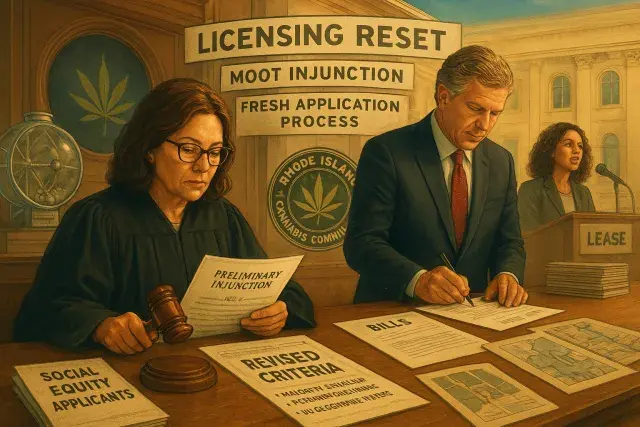
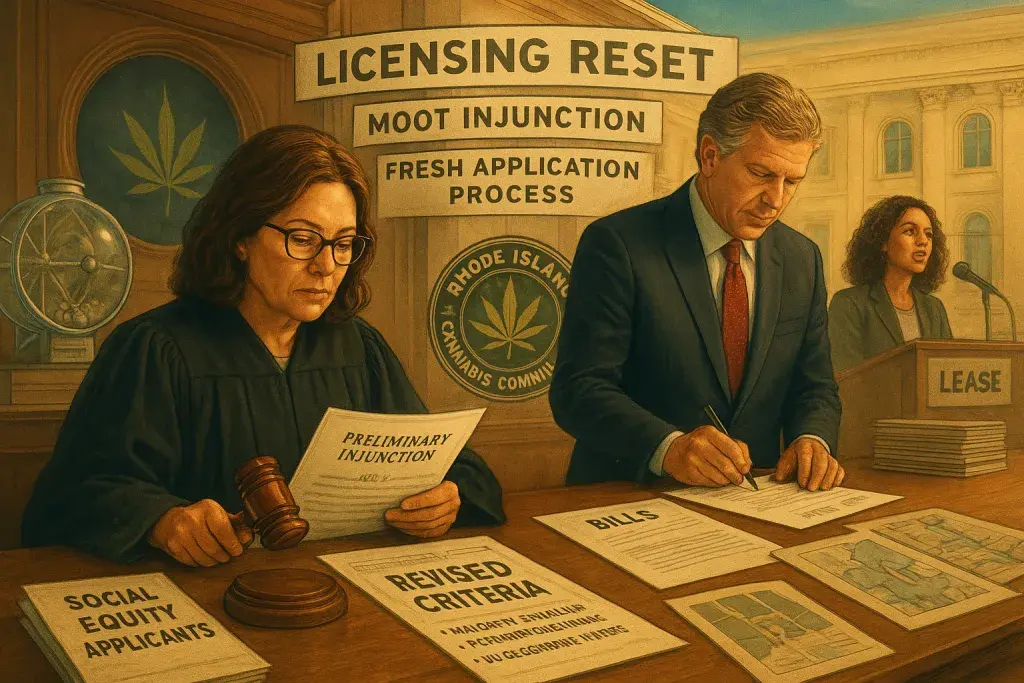
Rhode Island's Cannabis Control Commission has asked a federal judge to dissolve the preliminary injunction that froze its adult-use retail licensing process, arguing that new state legislation has rendered the court order moot. Governor Dan McKee signed two bills on June 10 that strip the original residency ownership requirement from the 2022 Rhode Island Cannabis Act - the very provision that triggered three separate federal lawsuits and ultimately stopped the state's first license lottery before it could happen.
The injunction, issued April 8 by US District Judge Melissa DuBose, blocked the commission from holding a lottery it had planned for May and halted any further screening of applications submitted before the December 29, 2025, deadline. The legal challenge centered on the original law's requirement that all recreational cannabis retailers be majority-owned by Rhode Island residents - a rule courts in other states have found difficult to square with constitutional commerce protections. Licensing structures that tie ownership eligibility to geography are a recurring fault line in regulated cannabis markets; for a closer look at how another New England state has structured its own licensing framework, see how it works in Maine. The commission's motion argues that because the legislature has now permanently removed the offending residency language, the injunction has nothing left to enforce. see how it works
State attorneys put it plainly in their filing: "The goals of this court's preliminary injunction have now been made permanent by the General Assembly's legislative action. Thus, this court's preliminary injunction is now moot and essentially a legal nullity." Whether DuBose agrees is the next question. Dissolving a preliminary injunction after underlying statutory changes is a recognized procedural path, but the judge will need to satisfy herself that the new law fully addresses the constitutional concerns she found sufficient to halt the process in the first place.
What Changed - and What It Means for Applicants
The new legislation does more than delete the residency clause. It voids the original application process entirely and directs the commission to open a fresh one within 60 days of the governor's signature - putting the target start date around August 10. Applicants are now defined broadly as any person or business that has submitted an application for a cannabis license or certificate, which preserves the standing of those who already applied without locking in the prior framework's terms.
The social equity provisions were also revised. Under the original act, eligibility for one of six social equity licenses included Rhode Island-specific references in the criteria. Those references are gone. Going forward, social equity applicants must demonstrate majority ownership by one or more individuals who were disproportionately affected by the criminal enforcement of past cannabis prohibition - including personal arrest history or a family member's arrest record. The policy intent remains intact; the geographic filter does not.
Here's the catch for the roughly 100 applicants currently in limbo: the new law does allow them to reclaim application fees they paid to the commission - $7,500 per application - but as of this week, no refunds have been issued. Commission spokesperson Charon Rose confirmed that staff are still mapping next steps. "We're hopeful that once we get the go-ahead with the appropriate people that we can get the process moving again," she said. The $30,000 annual licensing fee is not at issue yet, since no licenses were actually issued before the injunction landed.
The Business Toll Is Already Real
Application fees are one thing. Rent is another. Many of the hundred-odd applicants have been paying for retail storefronts - signed leases, ongoing monthly costs - against the possibility of a license that has now been delayed indefinitely. The new law does not provide a mechanism to recover those lease payments. That's not a technicality; for a small operator who committed to a storefront in anticipation of a May lottery, several months of rent on a location that cannot legally open is a material loss.
This is a pattern that plays out in newly regulated adult-use markets with some regularity. When licensing timelines slip - whether from litigation, regulatory capacity constraints, or legislative rewrites - the cost falls disproportionately on smaller, undercapitalized applicants. Multi-state operators with legal reserves and real estate flexibility absorb delays differently than a first-time applicant who took out a personal loan to cover their application fee and first month's rent.
Social equity applicants face compounded pressure. The first year's licensing fee was waived for approved social equity licensees under the original structure. Whether that waiver survives into the new application process is not yet confirmed - the commission has not detailed how prior commitments will carry over, if at all, into the reset process.
What Operators and Investors Should Watch Next
The immediate question is whether Judge DuBose grants the commission's motion to dissolve the injunction. If she does, the commission can proceed with its new application process on the August 10 timeline. If she declines - or requests additional briefing - the clock slips again.
Assuming the process moves forward, prospective licensees should expect a revised application framework, not simply a continuation of the prior one. The commission will need to publish new rules, likely reopen the application window, and clarify whether previously submitted materials carry forward or need to be resubmitted. Given that the original process has been voided by statute, the cleaner assumption is that a fresh submission will be required.
For real estate landlords and brokers active in Rhode Island's commercial market, the restart signals renewed activity - but wariness is warranted. Cannabis retail leases in licensing-uncertain markets carry unusual risk, and any landlord or tenant negotiating space for a prospective dispensary should build contingency language into the agreement. What's striking here is that Rhode Island has been trying to get its adult-use retail program off the ground since 2022, and the first attempt at a lottery has now been unwound entirely before a single license was awarded. The state is effectively starting over. The August deadline is real, but the path to actually opening licensed retail doors in Rhode Island still has several hurdles ahead of it.