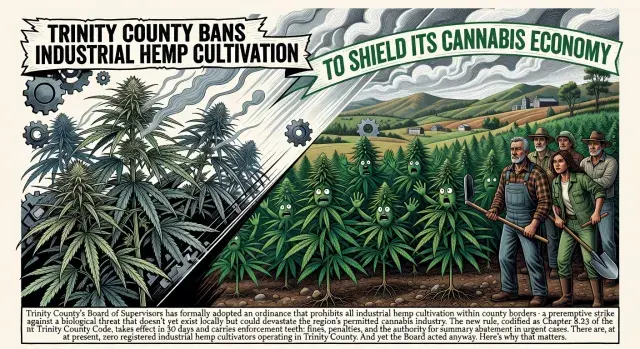
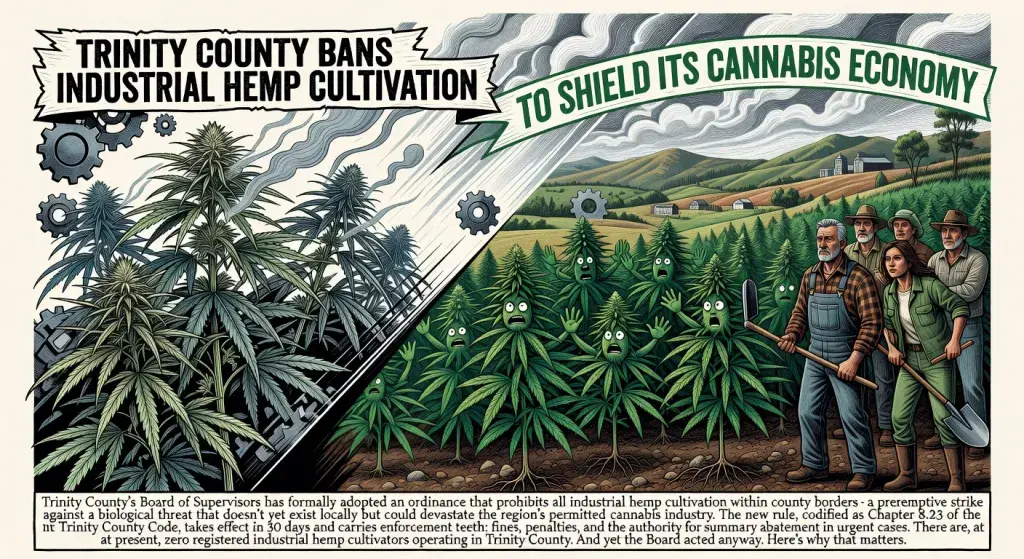
Trinity County's Board of Supervisors has formally adopted an ordinance that prohibits all industrial hemp cultivation within county borders - a preemptive strike against a biological threat that doesn't yet exist locally but could devastate the region's permitted cannabis industry. The new rule, codified as Chapter 8.23 of the Trinity County Code, takes effect in 30 days and carries enforcement teeth: fines, penalties, and the authority for summary abatement in urgent cases.
There are, at present, zero registered industrial hemp cultivators operating in Trinity County. And yet the Board acted anyway. Here's why that matters.
The Pollen Problem: Same Species, Incompatible Goals
Cannabis and industrial hemp are both varieties of Cannabis sativa L. To the naked eye, they're indistinguishable - only laboratory chemical analysis can reliably tell them apart. But from an agricultural and economic standpoint, they serve entirely different markets. Licensed cannabis growers in Trinity County cultivate female plants prized for their cannabinoid-rich, seedless flowers. Industrial hemp, grown primarily for fiber, grain, or CBD extraction, is a different commercial product with a shared and problematic biology.
Both plants are wind-pollinated. Hemp pollen can travel for miles. If it reaches female cannabis plants on a licensed farm, the result is cross-pollination - and that's not a minor inconvenience. Cross-pollinated cannabis plants produce seeded flowers, which materially diminishes their market value and can render a crop commercially unviable. For growers who depend on that harvest for their annual income, a rogue pollen drift event isn't an abstraction. It's a gut punch.
The ordinance itself puts it plainly: the prohibition "is necessary to protect the County-permitted commercial cannabis industry from pollen-drift impacts and related nuisance conditions."
Economic Stakes and the Logic of Prevention
Cannabis is one of the primary agricultural products driving Trinity County's economy. Hundreds of licensed growers depend on it. The county - rural, sparsely populated, and without the diversified tax base of California's urban centers - can't afford to treat pollen contamination as a hypothetical risk to be managed after the fact. Crop damage from cross-pollination isn't easily reversed. Once pollen lands, the harm is done.
That calculus explains why the Board opted for a blanket prohibition rather than, say, buffer zones or setback requirements. In a county where cannabis cultivation is widespread and wind patterns are unpredictable, half-measures would likely prove inadequate. The ordinance frames the ban as a legitimate exercise of the county's police power to protect public health, safety, welfare, and economic resources. State law explicitly permits counties to exercise this kind of local authority over hemp cultivation, and Trinity County isn't the first California jurisdiction to take this route.
What the Ordinance Actually Does
The key provisions are broad and enforceable:
- Complete prohibition: No person, entity, or property owner may establish, operate, or permit an industrial hemp cultivation facility anywhere in Trinity County.
- Nuisance designation: Any violation is classified as a public nuisance, subject to fines, penalties, and abatement.
- Summary abatement: Where a violation poses an immediate and substantial threat, the county can act to remove the nuisance without prior hearing - an aggressive but legally grounded enforcement mechanism.
- Environmental posture: The ordinance authorizes no new development or land disturbance and is categorically exempt from CEQA review.
Worth noting: this isn't entirely new ground. Trinity County has maintained a prohibition on hemp cultivation since 2019. The new ordinance formalizes and strengthens that position within the county code, giving enforcement officers clearer statutory footing.
A Broader Pattern in Cannabis Country
Trinity County's decision reflects a tension that runs through California's post-legalization agricultural policy. The state permits both cannabis and hemp cultivation, but the two industries are, at a biological level, incompatible neighbors. Several California counties with significant cannabis economies have grappled with this same question - and some have reached the same conclusion.
The policy tradeoff is real. Industrial hemp has legitimate commercial applications and its own set of advocates. But in a county where cannabis is an economic lifeline, the Board decided the risk equation pointed in one direction. Whether that calculus holds as hemp markets evolve and cultivation technologies improve remains an open question. For now, though, Trinity County has made its position unambiguous.
Residents and growers seeking additional detail can contact the Trinity County Community Development Department or the County Agricultural Commissioner's Office.