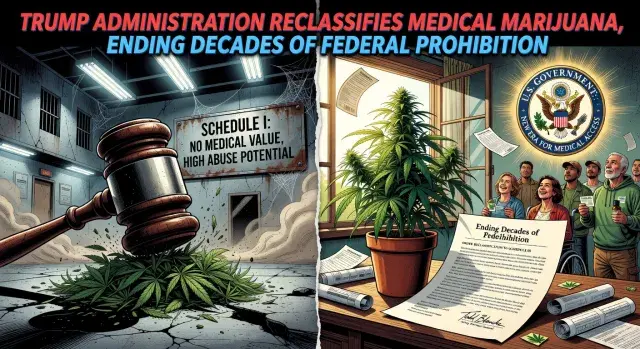
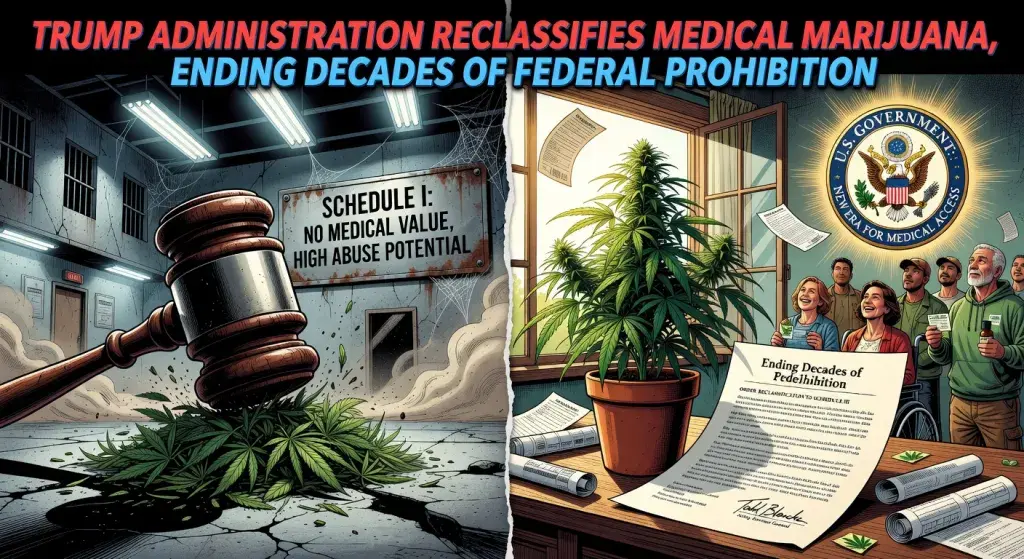
After nearly nine decades of treating cannabis as equivalent to heroin under federal law, the U.S. government has formally broken with that position. Acting Attorney General Todd Blanche signed an order Thursday moving state-licensed medical marijuana from Schedule I to Schedule III - a shift that doesn't legalize the drug but fundamentally alters its regulatory status, its tax treatment, and the federal government's posture toward the 40 states that already run medical cannabis programs.
The order also sets the stage for something broader: a hearing beginning in late June to consider reclassifying marijuana beyond just state-licensed medical use. The implications, both immediate and downstream, are substantial.
What the Order Actually Does - and Doesn't Do
Let's be precise. This is not legalization. Federal law still prohibits marijuana. What changed is the drug's classification under the Controlled Substances Act. Schedule I - the category marijuana has occupied since 1970 - is reserved for substances deemed to have no accepted medical use and a high potential for abuse. Heroin, LSD, and ecstasy sit there. Schedule III, by contrast, includes drugs with moderate to low dependence potential; think testosterone, ketamine, certain anabolic steroids.
The practical consequences are real, though. State-licensed medical marijuana businesses can now deduct ordinary business expenses on their federal taxes - something previously barred under Section 280E of the tax code. That's not a minor bookkeeping change; it's a financial windfall for an industry that has operated for years under a tax burden unlike any other legal business in America. Researchers, meanwhile, won't face penalties for obtaining state-licensed cannabis for studies. And state-licensed producers and distributors will gain access to an expedited DEA registration system.
Marijuana or marijuana-derived products sold outside a state medical program? Still Schedule I. The line drawn here is narrow and deliberate.
A Policy Shift Eighty-Eight Years in the Making
The federal government's prohibition of cannabis dates to the Marihuana Tax Act of 1937. Nearly nine decades later, the gap between federal classification and state-level reality had become absurd. Only Idaho and Kansas still ban marijuana outright. Two dozen states plus Washington, D.C., allow recreational adult use. Forty states run medical marijuana systems. Eight more permit low-THC cannabis or CBD oil for medical purposes.
California pioneered medical marijuana in 1996. In the years since, as Blanche himself acknowledged in the order, states have built "comprehensive licensing frameworks governing cultivation, processing, distribution, and dispensing of marijuana for medical purposes." The federal government, in effect, was classifying a substance as having no medical use while the vast majority of states operated regulated medical programs distributing it to patients. That tension had become untenable - and politically awkward for both parties.
Michael Bronstein, president of the American Trade Association for Cannabis and Hemp, called it "the most significant federal advancement in cannabis policy in over 50 years." That framing isn't hyperbole. The reclassification implicitly validates what states have been doing for nearly three decades.
The Opposition Isn't Going Quietly
Not everyone sees progress here. Kevin Sabet, who leads Smart Approaches to Marijuana, offered a blistering assessment: "With this move, we are now confronted with the most pro-drug administration in our history." He argued that policy was "being dictated by marijuana CEOs, psychedelics investors, and podcasters in active addiction." Sharp words - and they point to a genuine divide within Republican ranks.
More than 20 Republican senators, several closely allied with Trump, signed a letter last year urging the president to maintain marijuana's existing classification. The concern isn't abstract. Critics note that state legalization has coincided with increasingly potent cannabis products, and they argue that loosening federal restrictions sends mixed signals - particularly given the administration's aggressive posture on fentanyl, which Trump recently declared a weapon of mass destruction.
Here's the tension that won't resolve easily: Trump is simultaneously waging a militarized campaign against drug trafficking while easing restrictions on a substance that, under federal law, was until yesterday classified alongside heroin. The policy coherence there is, to put it generously, still under construction.
Legal Mechanics and Open Questions
Blanche sidestepped the lengthy review process that the Biden administration had initiated - a process that generated nearly 43,000 public comments and was still grinding through DEA review when Trump took office. Instead, he relied on a provision allowing the attorney general to classify drugs that the U.S. must regulate under international treaty obligations. It's a faster route. Whether it survives legal challenge remains to be seen.
There are also practical ambiguities. In states like Washington, which legalized recreational marijuana in 2012, hundreds of licensed retail stores hold endorsements to sell tax-free products to registered medical patients while also serving recreational customers. How this order interacts with those dual-purpose operations is unclear. The regulatory details will matter enormously - and they're still being worked out.
What's undeniable is the direction of travel. The federal government has, for the first time, formally acknowledged that state-regulated medical cannabis has a legitimate place in American healthcare. The hearing set for late June could push that acknowledgment further still. For an industry long caught between state permission and federal prohibition, Thursday's order doesn't resolve everything. But it resolves quite a lot.