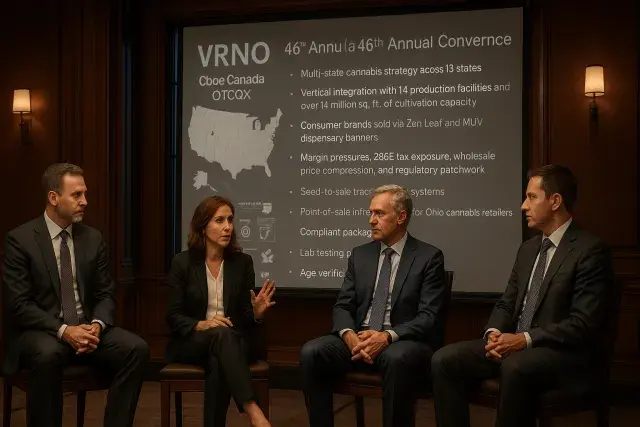
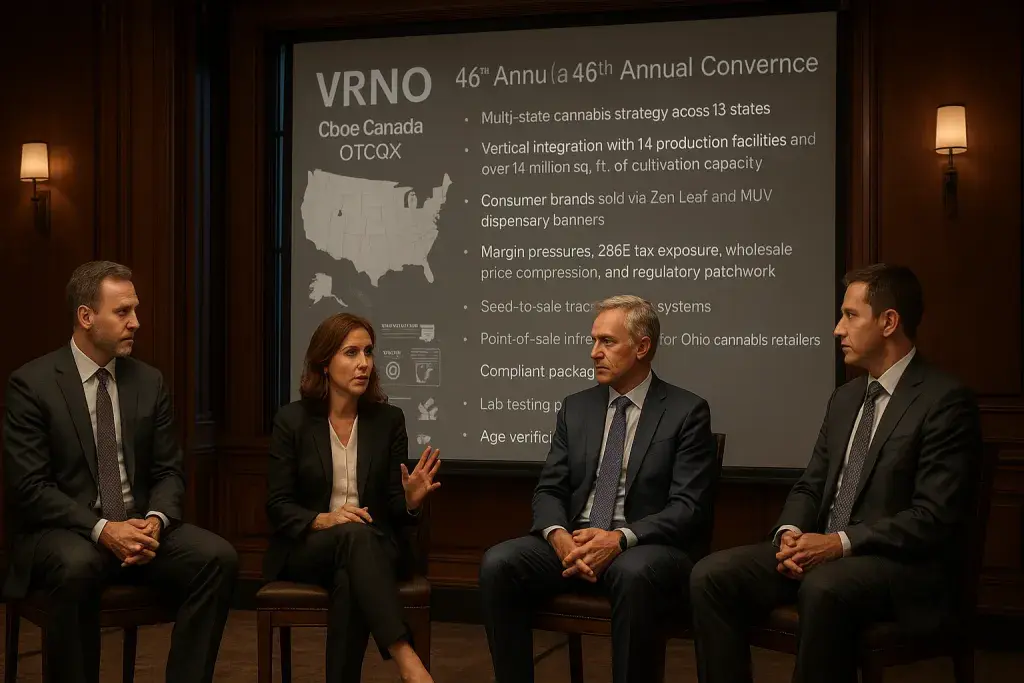
Verano Holdings Corp. will send members of its executive leadership team to the Canaccord Genuity 46th Annual Growth Conference in Boston on August 11, disclosed the multi-state operator, which trades as VRNO on Cboe Canada and the OTCQX marketplace. The appearance, structured as a fireside chat plus a slate of investor meetings, gives the company a public forum to address how it plans to manage margin pressure across a 13-state footprint at a moment when capital markets remain skeptical of cannabis equities generally.
That skepticism is not without cause. Multi-state operators have spent the past several years wrestling with 280E tax exposure, wholesale price compression, and a patchwork of state regulatory regimes that make it difficult to run a single operating playbook nationwide. Verano's answer has been vertical integration: 14 production facilities and more than 1.1 million square feet of cultivation capacity feeding a portfolio of consumer brands sold through its Zen Leaf and MÜV dispensary banners. That structure gives the company more control over cost inputs than a pure retailer would have, but it also means back-office systems have to keep pace. Retail-side technology choices, including seed-to-sale tracking and point-of-sale infrastructure, matter as much to investors as brand strength does; operators in newer adult-use markets increasingly rely on specialized platforms, and vendors offering POS software for Ohio cannabis retailers have positioned themselves around exactly this kind of compliance and inventory complexity. POS software for Ohio cannabis retailers
Why a Fireside Chat Matters to Operators Watching From Outside
Conference appearances like this one are not simply investor relations formality. For a company operating dispensaries and cultivation sites across more than a dozen states, each with its own licensing structure, tax treatment, and packaging rules, a fireside chat is often where analysts press for specifics on cash flow, store-level performance, and capital allocation that a press release will not spell out. Smaller operators and suppliers watching from the sidelines tend to use these sessions as a proxy for where the broader multi-state segment is heading, since Verano's scale makes it something of a bellwether for wholesale pricing trends and retail traffic patterns.
The Underlying Business Pressures Have Not Gone Away
Here's the catch with vertical integration: it concentrates risk as well as control. A cultivation shortfall or a compliance lapse at one facility can ripple through retail shelves in multiple states at once. Compliant packaging requirements, lab testing and certificate-of-analysis protocols, and age-verification standards at the point of sale remain non-negotiable costs of doing business, not optional extras, and they vary enough state to state that centralized compliance teams have become standard at operators this size. None of that disappears because a company is presenting well to investors in Boston; it simply becomes the backdrop against which growth claims get evaluated.
What This Signals for the Sector
Verano's participation is a data point, not a verdict, on where multi-state cannabis retail is headed. But it does suggest that even amid ongoing uncertainty around federal rescheduling and interstate commerce restrictions, larger operators are still courting institutional capital and betting that disciplined retail execution, paired with tight compliance infrastructure, will separate durable brands from the rest of the field.