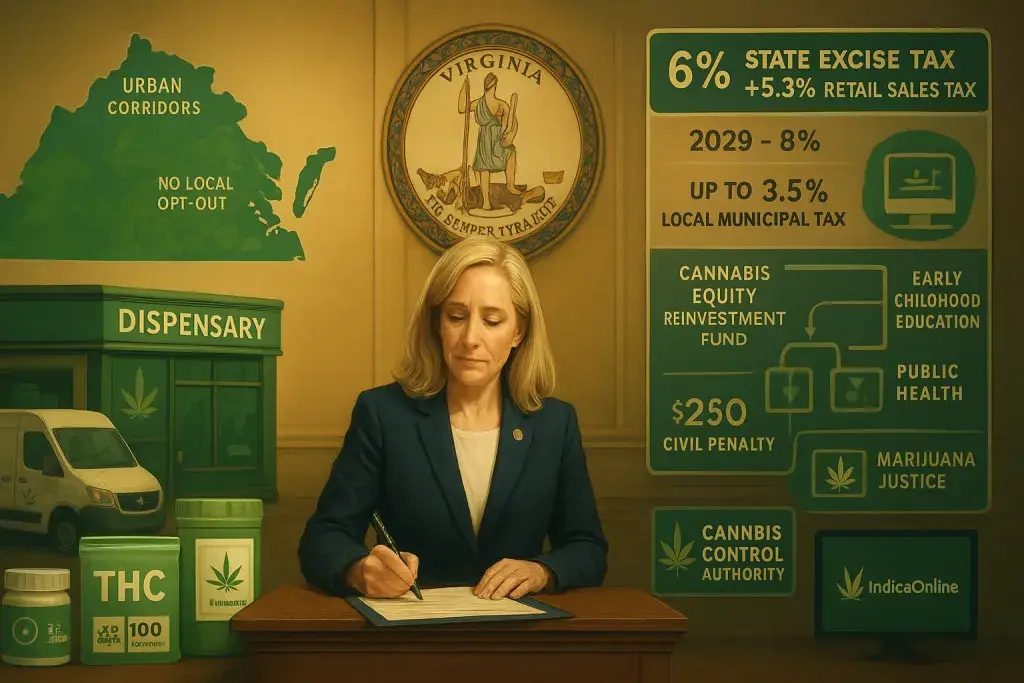
Virginia has a legal adult-use retail cannabis market on the books. After months of vetoes, negotiations, and legislative maneuvering, Gov. Abigail Spanberger signed off on a budget bill that includes a full framework for recreational marijuana sales - without requiring any further gubernatorial action, because lawmakers adopted her proposed amendments in their entirety. The market is now scheduled to open July 1, 2027.
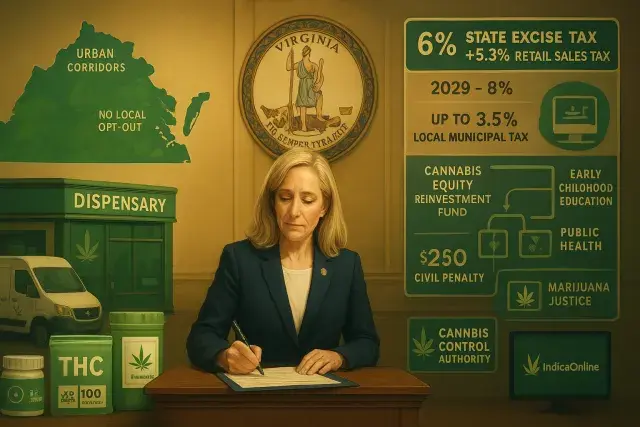
For dispensary operators, cannabis brands, ancillary vendors, and investors watching this state, that date is the operational anchor around which build-out timelines, licensing strategies, and wholesale agreements will now need to be structured. Virginia's Cannabis Control Authority will oversee licensing and regulation, and the state will cap retail licenses at 350 storefronts - a number meaningful enough to attract serious multi-state operators but constrained enough to keep license values elevated. Platforms already tracking Virginia's regulatory environment, like IndicaOnline in Virginia, will be monitoring how the Cannabis Control Authority operationalizes these rules as the 2027 launch approaches. Local opt-outs are prohibited, so operators won't face the patchwork of municipal bans that have hamstrung markets in other states.
The tax structure deserves close attention. Adult-use sales will carry a 6 percent state excise tax plus a 5.3 percent retail sales and use tax from the start, with municipalities permitted to layer on up to an additional 3.5 percent local tax. On July 1, 2029 - two full years into the market - the state excise tax steps up to 8 percent. For operators building five-year financial models, that two-year ramp matters: early pricing strategies, wholesale agreements, and margin assumptions will need to account for a tax increase that is already written into law. Revenue is designated for the Cannabis Equity Reinvestment Fund, early childhood education, behavioral health services, and public health initiatives - though the legislation does not specify what percentage flows to each, which leaves meaningful budget allocation questions unresolved.
What the Retail Framework Actually Looks Like
The per-transaction purchase limit is set at 2 ounces, up from Virginia's current 1-ounce possession limit, with equivalent thresholds for other cannabis product formats to be defined by regulators. Serving sizes are capped at 10 milligrams THC, with a 100-milligram-per-package ceiling - standard adult-use potency guardrails that will directly shape SKU development for manufacturers and brands entering the state. Delivery is permitted under the new framework, which opens a meaningful revenue channel for licensed operators and will require its own compliance infrastructure: delivery manifests, age verification protocols, and route-tracking systems that satisfy state oversight requirements.
Hemp regulation also shifts under the new law. The Cannabis Control Authority will absorb oversight of hemp from the Department of Agriculture and Consumer Services, and the definition of a legal hemp product will be narrowed - specifically, the existing provision allowing products with more than 2 milligrams of total THC per package if the CBD-to-THC ratio exceeds 25:1 is being removed. For hemp brands selling in Virginia, that is a compliance deadline worth calendaring now, well ahead of 2027.
The Penalty Provision That Advocates Won't Let Go
Here's the catch that has drawn the sharpest criticism of this otherwise broadly supported framework. The budget bill increases the civil penalty for public cannabis consumption from $25 to $250 - a 900 percent increase. Advocacy groups including the ACLU of Virginia, the Marijuana Policy Project, the Drug Policy Alliance, and Marijuana Justice have called this a "poverty penalty," and their concern isn't abstract. Enforcement data obtained through FOIA requests shows that since noncommercial cannabis legalization took effect in Virginia in 2021, Black residents have been charged with public consumption at a rate more than three times higher than white residents relative to their share of the state's population - despite roughly similar raw numbers of charges.
Spanberger's amendments did not touch the penalty provision. The compromise - a $250 civil fine rather than the class 4 criminal misdemeanor the governor had initially sought - is being framed as a middle ground, but advocates are not satisfied. For cannabis businesses operating in communities where this enforcement disparity is most acute, the reputational and community-relations dimension is real. Social equity is not just a licensing checkbox in most adult-use markets; it functions as a pressure point that shapes how regulators, elected officials, and community groups treat the industry long after opening day.
Operational Implications for Operators Entering This Market
The 2027 launch date gives the Virginia Cannabis Control Authority - now governed by a five-member board appointed entirely by the governor - roughly two years to build out licensing infrastructure, promulgate regulations, and stand up a compliance oversight system. That timeline is actually tighter than it sounds. States that have rushed licensing rollouts have consistently produced chaotic opening periods: supply shortfalls, point-of-sale compliance failures, seed-to-sale tracking gaps, and contested license awards. Operators who want to be positioned for day-one retail should be engaging legal counsel on licensing eligibility now and tracking regulatory rulemaking as it develops.
The 350-store cap, combined with the prohibition on local opt-outs, means the distribution of licenses across the state will matter enormously. Urban markets, suburban corridors, and rural areas will all fall under the same regulatory umbrella - but consumer density, real estate costs, and local enforcement culture will vary substantially. Operators scouting locations should factor in the 3.5 percent municipal tax ceiling, since localities that impose the maximum will create measurable price differences against neighboring jurisdictions. In thin-margin retail environments - and adult-use cannabis retail is a thin-margin business in mature markets - that spread matters to both pricing strategy and consumer behavior.
What's striking here is how long this state has been in regulatory limbo. Personal possession and home cultivation have been legal in Virginia since 2021. Former Gov. Glenn Youngkin vetoed sales legislation twice. Spanberger vetoed an earlier version of the sales bill earlier this year before negotiating the compromise now enacted. That four-year gap between possession legalization and regulated retail is not unusual across adult-use states, but it does mean a gray and informal market has had time to develop. Licensed operators entering in 2027 will be competing not just with each other but against patterns of consumer behavior that have formed outside the regulated system. Pricing, product selection, and the trust signals that come with compliant packaging, lab-tested products, and certificates of analysis will be the differentiation tools that matter.