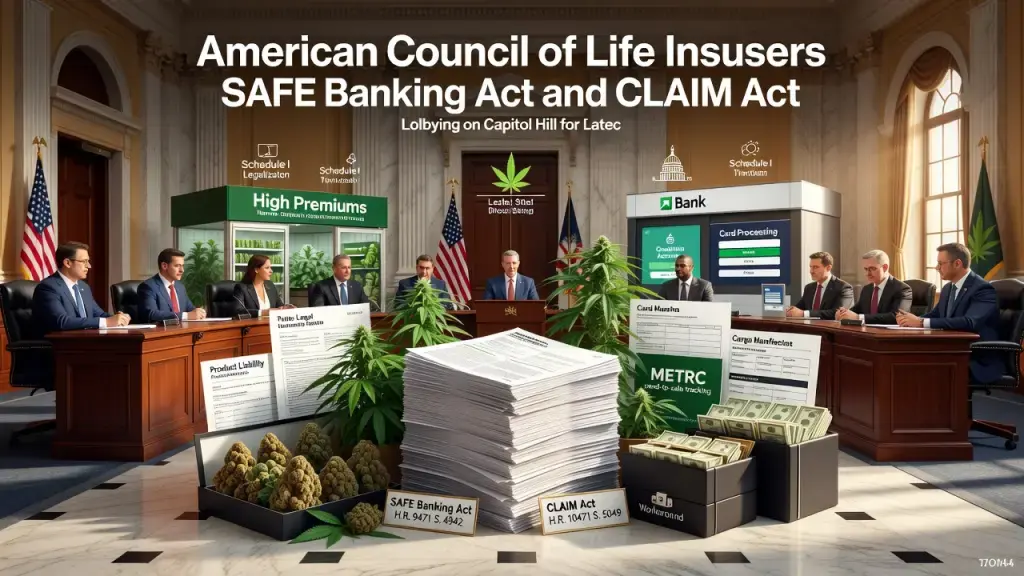
A trade group representing the nation's life insurance companies has formally weighed in on cannabis banking and insurance reform. The American Council of Life Insurers disclosed in a federal filing Monday that it lobbied Congress during the third quarter of 2026 on both the SAFE Banking Act and the newer CLAIM Act, two proposals that approach the same underlying problem from different angles.
The filing covers July through September and lists $1,002,681 in total federal lobbying spending - a figure that spans the association's entire agenda, not just marijuana-related measures. Still, the inclusion of these two bills is notable. It signals that mainstream financial-services players, not just cannabis operators and advocacy groups, now see federal inaction on marijuana banking as a problem worth spending lobbying dollars to fix.
Two Bills, One Underlying Problem
The SAFE Banking Act - filed as H.R. 9471 and S. 4942 - is familiar territory for anyone who has tracked cannabis policy over the past several years. It would shield banks and credit unions from federal penalties for serving state-licensed marijuana businesses, theoretically opening the door to normal checking accounts, lending, and card processing instead of the cash-heavy workarounds that still define much of the retail segment.The CLAIM Act, tracked as H.R. 10471 and S. 5049, extends that logic to insurance. Right now, insurers, brokers and agents who write policies for marijuana businesses operate under a cloud of federal ambiguity, since cannabis remains a Schedule I substance under federal law despite state-level legalization. That mismatch creates real exposure: an insurer covering a dispensary's property, inventory, or general liability could theoretically face federal scrutiny simply for doing business with a state-legal company.
Why Insurance Access Matters for Retail Operators
Here's the catch for dispensary owners and multi-state operators: a lack of available, competitively priced coverage isn't an abstract policy issue. It shows up directly in operating costs. Thin insurance markets tend to produce higher premiums, narrower coverage terms, and fewer carriers willing to underwrite cannabis risk at all - covering everything from budroom inventory and product liability to crop loss at cultivation sites and cargo risk on delivery manifests.When fewer insurers compete for that business, operators pay more for less protection. That's a real cost pressure layered on top of 280E tax exposure, compliance overhead from seed-to-sale tracking systems like METRC, and the cash-management headaches that persist even where some banking access has opened up. The CLAIM Act, if it moves, wouldn't eliminate those pressures - but it would widen the pool of carriers willing to underwrite the risk, which tends to push pricing down over time.
Momentum Building, Outcome Still Uncertain
The timeline here matters. Senators Kevin Cramer and Ruben Gallego introduced the CLAIM Act in the Senate in July; Representatives Nydia Velázquez and Warren Davidson brought a House companion in September. Shortly after the House version dropped, the American Council of Life Insurers joined eight other insurance industry groups in publicly endorsing it - a coordinated show of support from an industry not typically associated with cannabis advocacy.That bipartisan sponsorship pattern, pairing lawmakers from both parties in both chambers, is the kind of structure that has kept SAFE Banking alive through multiple Congresses without actually reaching a president's desk. Whether CLAIM follows the same long, stalled path or moves faster because it rides alongside SAFE Banking's more established coalition remains an open question. For now, operators and insurers alike are left watching committee calendars rather than celebrating a resolved issue.
What Operators Should Watch Next
- Whether SAFE Banking and CLAIM advance as a package or on separate legislative tracks
- Committee assignments and markup schedules in both the House and Senate
- Additional trade association endorsements, which can signal shifting institutional appetite
- Any state-level insurance regulatory actions that might move independently of federal reform
None of this changes day-to-day compliance obligations - operators still need compliant packaging, accurate lab testing and COAs, and disciplined inventory logs regardless of what happens in Washington. But for owners weighing expansion, refinancing, or renewing commercial policies, the direction of these two bills is worth tracking closely.